Search
Museum
Front Doors
Roman
Dark Ages
Vikings
and Normans
Monastic
15th and 16th C
17th and 18th C
Early 19th C
Late 19th C
20th C
FPS
Archive Material
The
Breed Today
Wild Fells
Quizzes
and Jigsaws
I
used that
Audio,
video, animations
Dalemain
UK Maps
Feedback
Thanks
Links
|
Why
three ponies and not just one?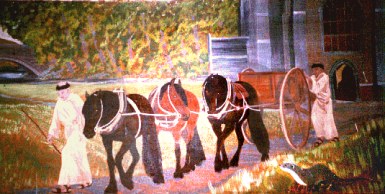
The
cart and harnessing methods illustrated here
are consistent with the Lutrell Psalter where
ponies are shown harnessed in "randem" using
rope traces and led by a man at the head of
the leading pony. A large amount of power would
be
needed to pull a cart loaded with blocks of
stone. The collars are fitted with carved wooden
hames
similar to those found on the Continent. The
cart had no springs. It would only be useful
in areas where the monks maintained level and
firm roads.
Other tracks degenerated
rapidly under pack traffic into hollow ways
with deep
mud in winter. "The routes used by the packhorse
trains characteristically ascended steep
valley sides in sharp zigzags, and spread out
on the
felltops, making diversions around boggy
ground. Deep hollow-ways scar the slopes of
Blease
Fell and Uldale Head..." (Lambert).
Rakkers
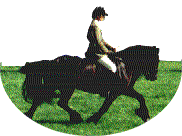 North
country farmers are recorded in the 13th
and 14th centuries as specialised in the
breeding and training of Fell ponies which
they sold to wealthy townsmen and gentry
as suitable mounts for long journeys. A significant
feature of these ponies was their economical
long striding action, comfortable to ride
for long distances as well as relatively
fast. They are referred to in wills, records
and inventories of the time as “rakkers” or "raks”,
a term used loosely to refer to riding animals
of different types which moved at speed with
each foot hitting the ground separately in
turn. Some modern gaited horses such as American
Saddlebreds are still described as doing
a fast or slow "Rack" or "Singlefoot". North
country farmers are recorded in the 13th
and 14th centuries as specialised in the
breeding and training of Fell ponies which
they sold to wealthy townsmen and gentry
as suitable mounts for long journeys. A significant
feature of these ponies was their economical
long striding action, comfortable to ride
for long distances as well as relatively
fast. They are referred to in wills, records
and inventories of the time as “rakkers” or "raks”,
a term used loosely to refer to riding animals
of different types which moved at speed with
each foot hitting the ground separately in
turn. Some modern gaited horses such as American
Saddlebreds are still described as doing
a fast or slow "Rack" or "Singlefoot".
This
does not necessarily imply that all the Fells
were gaited, but that some of them were included
in a group of animals that were comfortable
to ride. In the north a "rakker" was
an "easy-moving animal". (
ref
)
After the defeat at Bannockburn—Robert the Bruce
being at the height of his power—the
King's advisers felt that such an important fortress as Brough Castle
should
be fortified by more powerful hands than Idonea de Clifford could manage
to garrison it with. That it ought to dominate the Westmorland side of
the great Stainmore Pass. Accordingly the king entrusted the castle to
Robert de Welle, Knight, who was instructed to maintain 15 men-at-arms
fully mailed and mounted on "covered war horses," and 20 hobelars
or light lancers mounted on "hobby" or fell ponies. And to
show the importance the government placed upon this, it was willing
to grant the exceptional subsidy of placing 10 men-at-arms and 10 hobelars
on the king's pay. (British
History)
In
the 12th Century, moneys paid for stock by
the King were recorded in an annual Great
Roll of the Exchequer: from which we know
that in 1193/94/95, a foal was valued at
1 shilling, a brood mare at 5 shillings and
a team of 8 oxen at £1 (2s and 6d each).
By
the start of the 13th C a mare (breed unspecified)
was worth 1 mark (13 s 4d) and a "palfrey" or
comfortable pacing saddle horse 2 marks (£1
6s 8d). (ref)
We also know how much horseshoes cost, and
that they were nailed on for use: when
King John's
treasury paid the bills for Lancaster Castle
in 1209/1210, amongst the items were "1,900
horse shoes and nails at ½d each".
(It seems probable that the cost was for "a
shoe and its nails" as one item.)
Later
writers reveal that the gaited horse was
still valued for comfort up to the 17th Century
although it was becoming rarer. Gervase Markham,
perhaps best known in the horse world for
his "Discource of Horsmanshippe: How
to chuse, ride, traine, and diet, both hunting-horses
and running horses", followed it in
1605 with a treatise on "How to trayne
and teach horses to amble". (ref)
|

